
Checking Criminal History in Lynn County
A Lynn County criminal record check works best when the request starts with a record type, not just a person's name. A new arrest points to the agency that made the arrest and the Lynn County Sheriff at the jail. A felony case belongs with the District Clerk. The County Clerk holds County Court misdemeanor files, while Tahoka Municipal Court handles its city citations and other fine-only matters. The Texas Department of Public Safety supplies a separate statewide view of reported convictions and deferred adjudications.
Gather the full legal name, any prior name, date of birth when its use is lawful, the event year, and a case or incident number if known. Precise details matter in Lynn County because the County Clerk's request form states that staff do not perform searches. A name match from a state portal also needs care. DPS warns that name-based results can identify the wrong person or miss the right one.
- Decide whether the target is an arrest, booking, filed court case, warrant event, conviction, or custody record.
- Call the Lynn County office that created or keeps that item and confirm its current request method.
- Give the clerk or records custodian a cause number, incident number, date range, and exact name when available.
- Compare the local record with the appropriate DPS, VINE, TDCJ, or federal source when the question crosses systems.
- Order a certified court copy or fingerprint-based personal review when identity or final disposition must be proved.
Four Lynn County Record Counters
No single Lynn County criminal history counter holds the whole chain. The courthouse at 1501 South 1st Street houses the District and County Clerk routes. The sheriff and jail operate at 810 Lockwood Street. Tahoka keeps municipal citations at City Hall, and DPS maintains the statewide repository. The official Lynn County department directory is the starting point for current county contacts.
| Custodian | Best record target | Access route |
|---|---|---|
| District Clerk | 106th District felony case file | 1501 S. 1st St.; 806-561-4274 |
| County Clerk | County Court misdemeanor file | P.O. Box 937; 806-561-4750 |
| Lynn County Sheriff | Booking, custody, and sheriff reports | 810 Lockwood St.; 806-561-4505 |
| Tahoka Municipal Court | City citations and fine-only cases | 1807 N. Main St.; 806-561-4211 |
| Texas DPS | Reported public conviction history | Online CRD account or official request |
This split explains why a sheriff booking sheet cannot prove the court outcome. It also explains why the clerk cannot supply a police narrative. Ask each Lynn County custodian for the part it owns, then compare those parts rather than treating one result as the full record.
The county government landing page shows how Lynn County routes visitors among departments.
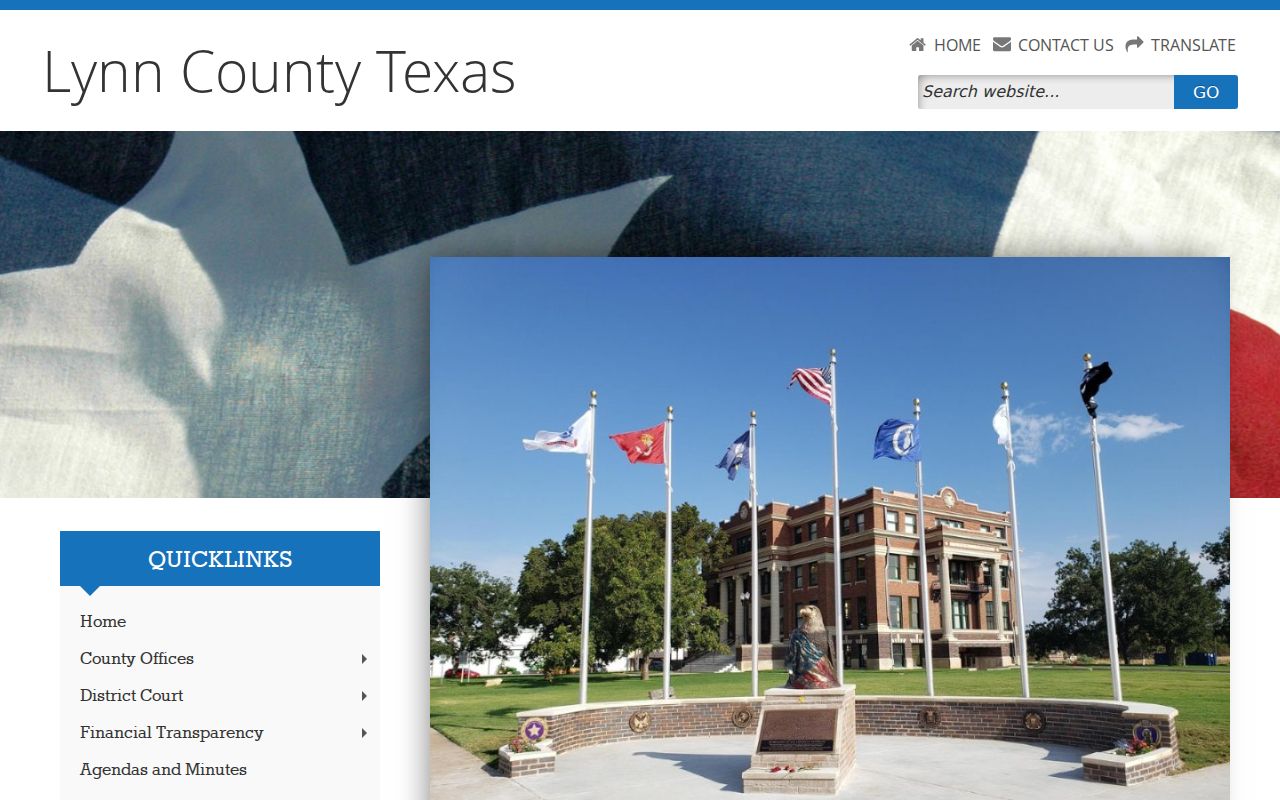
Its department-first layout reflects the local search method: choose the office before asking for a record.
Texas Official Background Checks
Texas DPS offers two distinct paths. The public Criminal History Conviction Name Search uses names and demographic details. Its public output covers conviction and deferred-adjudication information reported to DPS. It is not fingerprint identification, and it is not a live feed of every Lynn County arrest. A missing public hit does not prove that no arrest or non-conviction case exists.
A person reviewing their own Texas history can use the fingerprint-based DPS route. Fingerprint Applicant Services of Texas uses IdentoGO by IDEMIA for electronic capture. This identity-based process is better suited to finding an incomplete disposition or another error in one's own repository record. The FBI Identity History Summary is a separate subject-only federal route and does not replace Lynn County court files.
| Official product | Posted charge | Main limit |
|---|---|---|
| DPS online name search | $1 credit per search, plus posted card charges | Name match; public convictions and deferred adjudications |
| DPS offline name check | $10 | Mail and processing time; same name-match limits |
| DPS personal fingerprint review | $15 plus $10 FAST electronic printing | Subject's own Texas repository history |
| FAST two hard cards | $20 | Cards are an input, not a record report |
| FBI Identity History Summary | $18 plus printing or channeler costs | Subject's own federal identity history |
Lynn County DPS Search Fields
A Lynn County name search through DPS requires an account and prepaid credits. The working interface may require sign-in before it displays every control. Use the most complete legal spelling available, then narrow a candidate with date of birth and other lawful identifying details. Do not assume an apparent match is certain merely because the county or a similar name lines up.
| Field | Use | Caution |
|---|---|---|
| Last name | Primary name route | Spelling and sound-alike behavior affect results |
| First name | Primary given name | Use the full legal spelling when known |
| Middle name | Narrowing field | May be optional |
| Date of birth | Strong disambiguator | Use an exact date only when known |
| Sex or race | Extra narrowing control | Availability can depend on the live form |
The DPS search landing screen is the official entry to the name product.
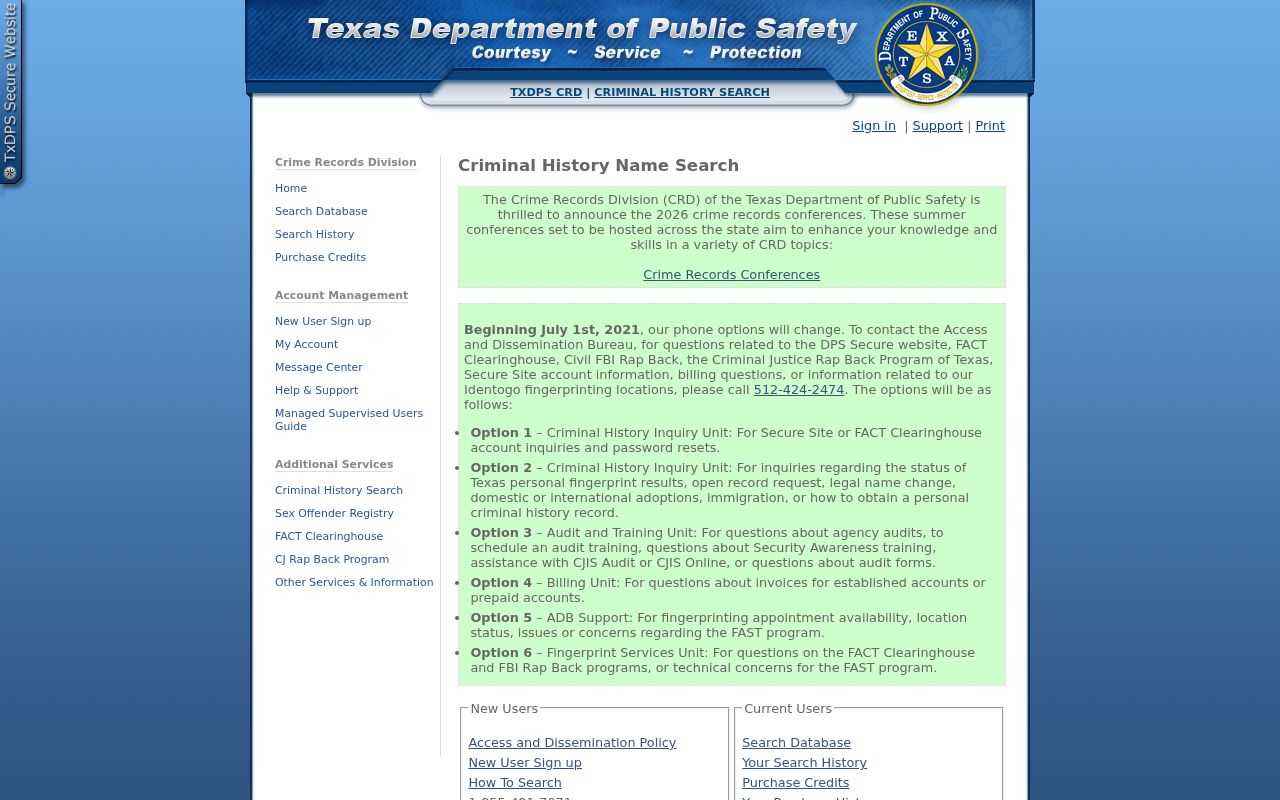
The state screen adds a reported statewide conviction layer, but it does not replace a Lynn County clerk's judgment or docket.
DPS also publishes search instructions and current credit terms.
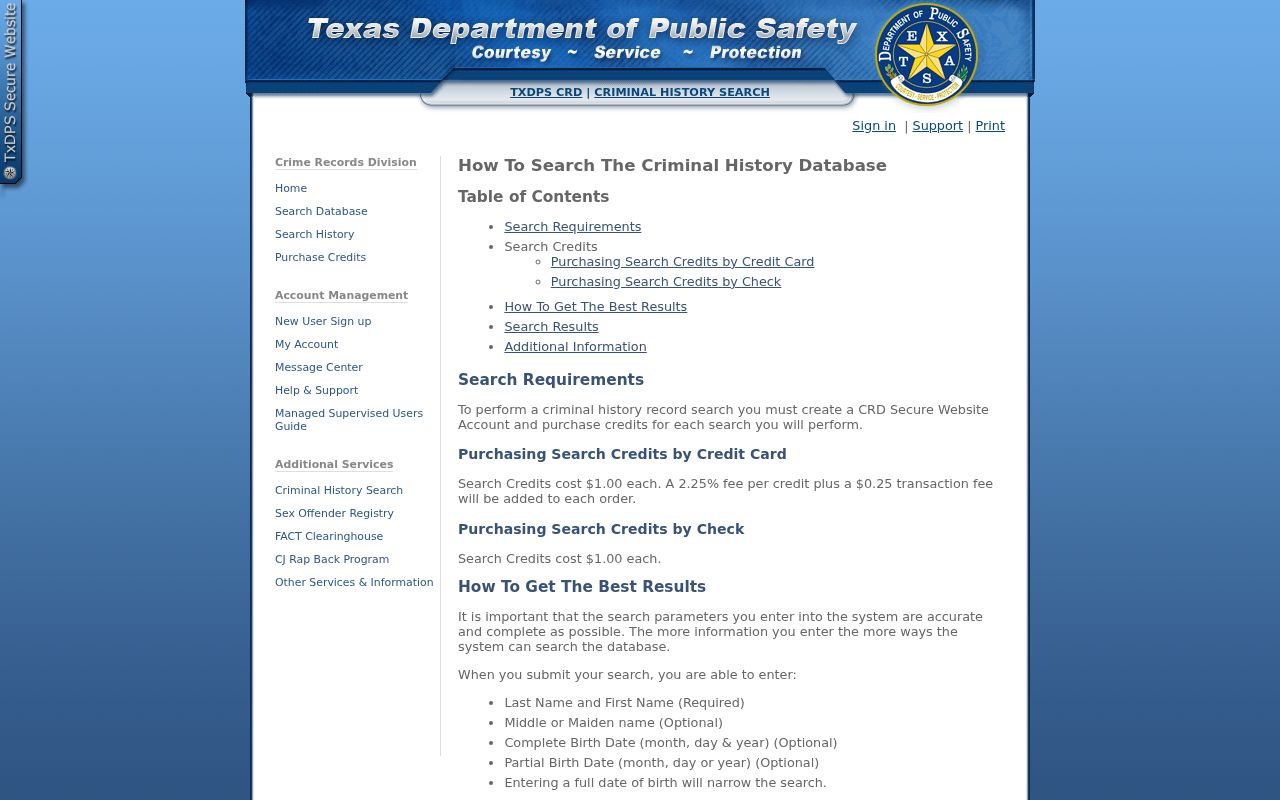
Those instructions make the product's fee and name-match limits visible before a Lynn County searcher relies on a result.
Criminal Record Types
Lynn County records document different stages. Police and deputies create incident and arrest reports. Jail staff create booking and custody entries. Prosecutors and clerks create charging and court files. DPS compiles reportable arrest cycles and dispositions sent by Texas agencies. Courts issue warrants, while supervision offices keep probation or parole material. Each record can be accurate about its own stage without answering what happened later.
- Arrest and booking records: show intake, arrest charge, bond, and custody details, not guilt.
- Court case files: show the filed charge, docket events, plea or verdict, judgment, and sentence.
- DPS history: compiles qualifying Texas agency reports, with a narrower public name view.
- Warrant records: arise from an issuing court and require current court or sheriff confirmation.
- Custody and supervision records: distinguish Lynn County jail, TDCJ prison, community supervision, and parole.
- Registry records: publish fields that Chapter 62 makes public for safety and awareness.
The arresting charge may change after a prosecutor reviews it. A case may be declined, dismissed, amended, or resolved under a different charge. For that reason, a Lynn County criminal history check should move from the first report to the filed court disposition whenever a case exists.
Lynn County Custody Record Split
Lynn County publishes no county-hosted jail roster or booking blotter. The Sheriff's official page points to Texas VINE for custody status and notifications. A caller can also contact the jail at 806-561-4505 for current placement, booking-copy, bond, or transfer questions. A written Texas Public Information Act request can seek an existing booking record, subject to lawful redaction and cost rules.
Placement can be less obvious than the arrest county. Commissioners' records show that Lynn County both houses people for other counties and uses cross-county arrangements. Historical counts include 37 people on June 9, 2025, of whom 25 were local, and 38 total on December 22, 2025 with several contract counties represented. Those figures explain the system; they are not current daily totals. Confirm the physical facility instead of guessing from the booking county.
After a sentence, the search channel may change. The official TDCJ Inmate Information Search covers state imprisonment and related status, while the Bureau of Prisons locator covers federal custody. Neither database supplies a Lynn County pretrial booking sheet.
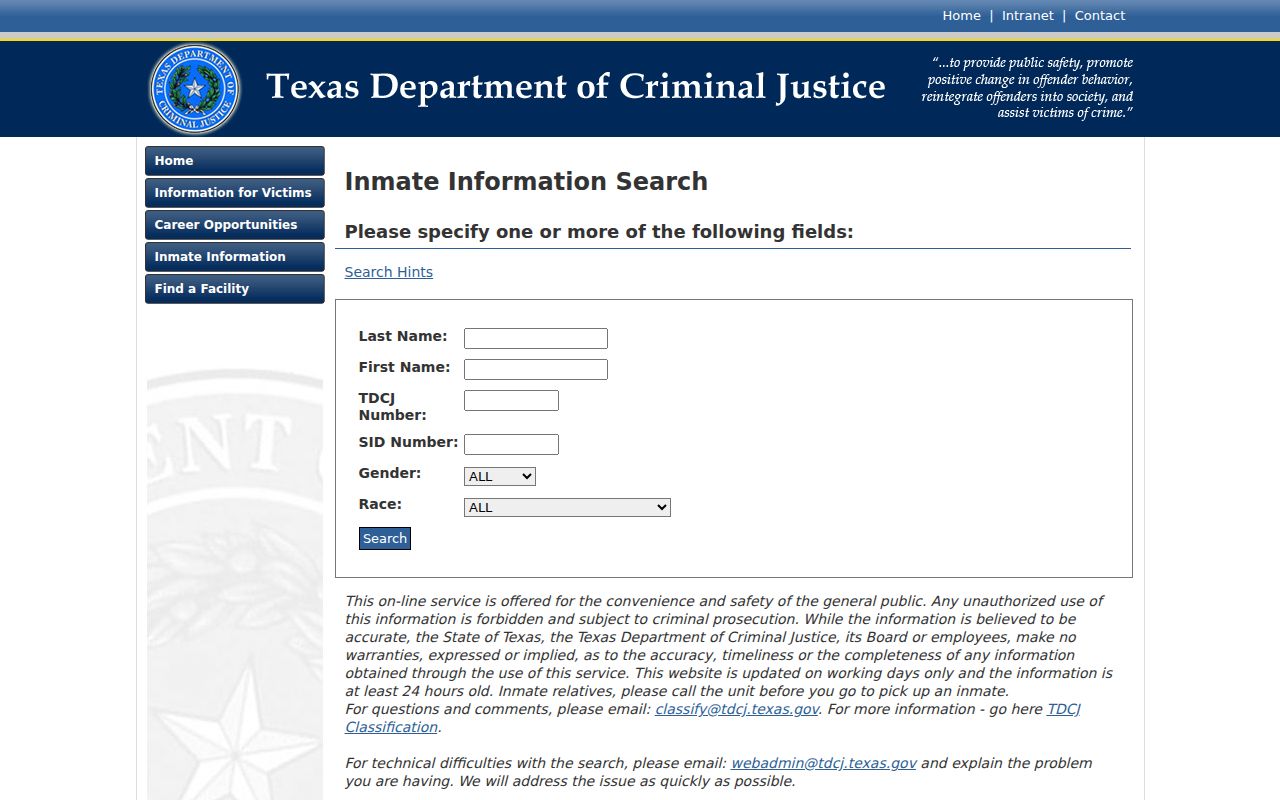
The TDCJ screen is the right next step only after the record has moved beyond county custody into the state system.
Inside a Lynn County Criminal Record
The fields depend on the custodian. A clerk file can carry a cause number, court, charge, docket, counsel, judgment, and sentence. A booking sheet centers on intake, arresting agency, bond, and release or transfer. A DPS history links an arrest cycle to reported prosecutor and court outcomes. Public views should omit protected Social Security numbers, account details, juvenile data, and victim information that law shields.
| Name and identifiers | Legal name, aliases, birth details, and agency identifiers as law permits. |
|---|---|
| Arrest and booking data | Arrest agency, date, intake number, arrest charge, bond, and custody movement. |
| Charges and statutes | Officer allegation, complaint, information, or indictment with offense level. |
| Disposition | Dismissal, plea, verdict, deferred adjudication, acquittal, or other filed result. |
| Sentence | Confinement, fine, costs, restitution, or community supervision in the judgment. |
| Custody or supervision | County custody, TDCJ status, probation events, parole status, or release details. |
Read dates as well as labels. A setting is scheduled activity, not an outcome. An indictment is a charge, not proof. A dismissal ends that prosecution but does not by itself erase the linked arrest. The final signed judgment and later orders are the best Lynn County court sources for the legal result.
Lynn County Clerk Search Limits
The County Clerk's official-public-record form contains a crucial Lynn County instruction: the office does not perform searches. That means a broad request to research every record attached to a name may fail. Supply the party or case, relevant year, document description, and cause or instrument number when known. State whether a plain or certified copy is needed, and ask for the current cost and payment method before sending funds.
Felony requests go to District Clerk Courtney Odom at 1501 South 1st Street, P.O. Box 939, Tahoka, TX 79373, or 806-561-4274. County Court criminal files go to County Clerk Karen Rendon at P.O. Box 937 or 806-561-4750. Both offices use Local Government Solutions internally, but neither advertises a public anonymous Lynn County criminal case screen.
District Clerk
1501 S. 1st St.
Tahoka, TX 79373
806-561-4274
106th District felony files
County Clerk
P.O. Box 937
Tahoka, TX 79373
806-561-4750
County Court criminal files
Sheriff and Jail
810 Lockwood St.
Tahoka, TX 79373
806-561-4505
Bookings and sheriff reports
Public Access Laws in Texas
The Texas Public Information Act reaches existing information held by a governmental body unless an exception allows withholding. It does not force an office to answer research questions or create a report. Court and judicial records also follow court access rules, so a request to a Lynn County clerk may use a different route from a request for a sheriff incident report. Confidential juvenile, victim, medical, and active-investigation material may be withheld or redacted.
Key Texas authorities:
Government Code Chapter 552 gives the public a route to existing government information, subject to exceptions.
Government Code Sections 411.083, 411.084, and 411.135 govern criminal-history confidentiality and the public DPS product.
Code of Criminal Procedure Chapter 66 assigns statewide reporting roles to agencies, prosecutors, clerks, and custodians.
Code of Criminal Procedure Chapter 55A sets the requirements for qualifying expunctions.
Code of Criminal Procedure Chapter 62 controls registry duties, public fields, and lawful use.
Send the request to the body that holds the record. The sheriff cannot certify a District Clerk judgment. The County Clerk cannot produce a Tahoka police video. Describe an existing item, date range, report or cause number, and preferred format so the Lynn County office can identify responsive material.
Lynn County Warrant Record Gaps
No official Lynn County active-warrant list, public search form, most-wanted page, or sheriff app was located in the research. A public name search therefore cannot clear a warrant. Call the issuing court at its official number and use the sheriff for safe confirmation. Felony and County Court warrant events may appear with the District or County Clerk. JP Precinct 1 can be reached at 806-561-4337, JP Precinct 4 at 806-428-3711, and Tahoka Municipal Court at 806-561-4211.
Ask for the cause or warrant identifier, current status, bond or balance, and lawful appearance options. A capias may follow a failure to appear or another court order. A capias pro fine concerns enforcement after a fine judgment. A search warrant serves a different purpose and is not a criminal-history product. Sealed, juvenile, or unexecuted matters may remain unavailable.
Note: Confirm clearance in both court and law-enforcement systems after payment, appearance, recall, or another resolving order has processed.
Sealed, Expunged, and Restricted Records
Texas expunction and nondisclosure are different remedies. Chapter 55A expunction can direct agencies to remove or destroy qualifying arrest and case records. An order of nondisclosure restricts public release of eligible material but preserves access for criminal-justice bodies and other recipients named by law. A dismissal alone does not guarantee either remedy. The arrest outcome, filing history, waiting period, criminal episode, and prior supervision can matter.
A Lynn County expunction review should begin with a fingerprint-based DPS personal record and certified local dispositions. Identify each arresting agency, jail, prosecutor, clerk, and repository entry tied to the event. Confirm the filing court, current fee, service list, and proposed-order practice with the District Clerk. No county self-help packet, fixed fee, clinic, or standard processing time was located.
- Expunction
- A Chapter 55A order for qualifying records to be removed or destroyed as the law directs.
- Nondisclosure
- A court order that limits public release but keeps the record available to listed recipients.
- Deferred adjudication
- A plea followed by supervision while the court defers a final finding of guilt.
- Disposition
- The recorded outcome of a charge or case.
Lynn County Charge Record Classes
Texas offense grade helps route a Lynn County court search. Felonies, including state-jail through first-degree offenses, are tried in the 106th District Court. Ordinary Class A and B misdemeanors belong in the constitutional County Court. Fine-only Class C matters may fall within municipal or justice court jurisdiction. Enhancements and offense-specific rules can change the grade, so the arrest shorthand should not be treated as the final classification.
The charging instrument and judgment provide a stronger answer. A complaint can begin the process. An information is commonly used for a misdemeanor where law permits, while a felony may proceed through grand-jury indictment. A booking label may remain in an early record even after the prosecutor files a different count. Check the Lynn County clerk file for the filed charge and final result.
Community supervision adds another layer. The 106th Judicial District Community Supervision and Corrections Department manages adult probation in Lynn County, while TDCJ handles state parole supervision. Public docket entries may show a sentence or a motion to revoke, but officer notes, treatment details, and other sensitive supervision material are not the public judgment.
Lynn County Justice Record History
Lynn County's records geography reflects its history. The county was organized in 1903 with Tahoka as its seat. The current courthouse dates to 1916 and once combined courtrooms, offices, and jail space. Its modern successor functions are split: court clerks remain at the historic courthouse, while today's sheriff and jail operate on Lockwood Street. The restored building was rededicated in 2019 after work that preserved its Classical Revival features.
The four-county 106th Judicial District also shapes felony records. The district judge and district attorney have administrative contacts in Lamesa, while the Lynn County District Clerk keeps local felony case files in Tahoka. A reader may see officials or settings tied to the wider district even when the prosecution belongs to Lynn County. That arrangement is normal, not proof that the record sits in another county clerk's office.
Lynn County Criminal Records by City
City-level records add the first layer to many Lynn County events. Tahoka Police creates city incident reports and Tahoka Municipal Court keeps its fine-only files. O'Donnell routes public-information questions through City Hall and has JP Precinct 4 nearby. Wilson's code establishes municipal fine-only jurisdiction, but no public city case portal was located. The 2020 Census ranks these as the county's three largest incorporated cities.
Tahoka Criminal Records
2,375 residents · City police reports and municipal citation channels
O'Donnell Criminal Records
704 residents · City Hall routing and JP Precinct 4 records
Wilson Criminal Records
434 residents · Municipal fine-only jurisdiction and county fallbacks
Correcting Lynn County Criminal Records
Start a correction with the source of the wrong fact. A mistaken booking field belongs with the arresting agency or jail. An incorrect disposition belongs with the clerk that entered the judgment. A DPS repository gap may require certified court material plus the agency's challenge procedure. Obtain a fingerprint-based personal review first when identity is in doubt, since a public name search is not a firm identity match.
The official Texas FAST appointment system is the route for electronic fingerprint capture.
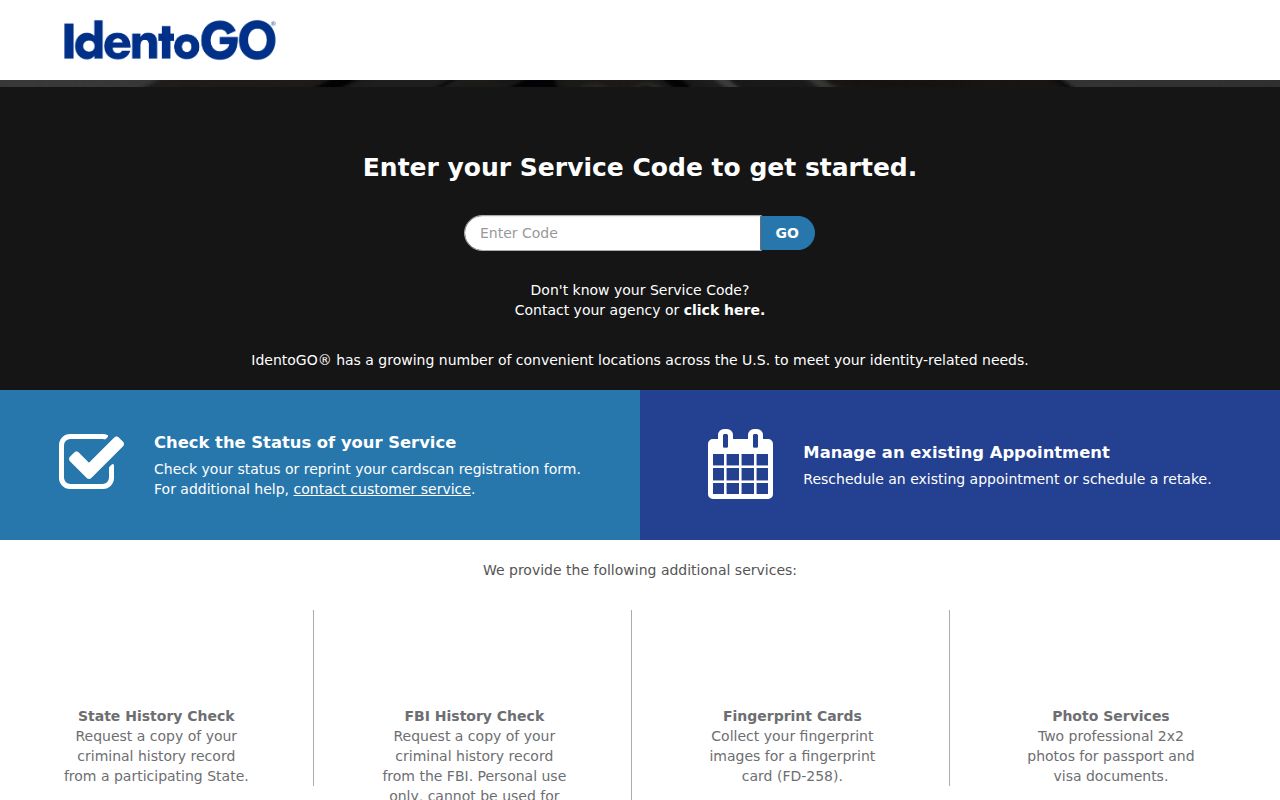
The appointment screen helps the record subject locate an available capture site; no stable IdentoGO center inside Lynn County was confirmed.
Keep copies of the original record, the certified correction, and all submission receipts. Then check the clerk index and a fresh DPS personal history after a reasonable processing period. Different Lynn County and Texas systems update on different schedules, so one corrected source may not instantly repair every downstream display.